











NIT Rourkela Develops Jackfruit Peel-Based Material to Purify Fluoride-Contaminated Water
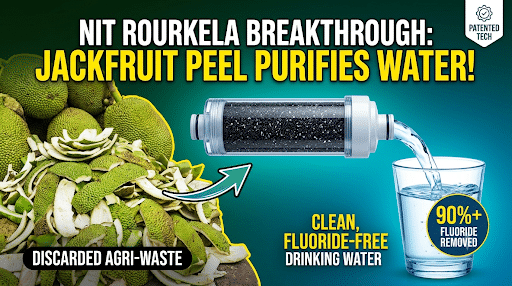
Rourkela, Odisha: Researchers at NIT Rourkela have developed an innovative and sustainable water purification material using discarded jackfruit peels that can remove more than 90% of fluoride from contaminated drinking water within minutes.
The breakthrough offers a promising solution for millions of people living in fluoride-affected regions across India.
The research was led by Prof. Susmita Mishra and Dr Pratima Minz from the Department of Chemical Engineering.
The team converted jackfruit peel waste into activated carbon and enhanced its fluoride-removal capability through zirconium modification.
Laboratory tests demonstrated that the material can remove between 90% and 97% of fluoride from water containing 1 to 5 mg/L fluoride concentrations in just 10 to 20 minutes.
Excess fluoride in drinking water remains a serious public health concern in many parts of India, often leading to dental and skeletal fluorosis.
Conventional treatment methods, including reverse osmosis systems, can be expensive and generate wastewater, limiting their adoption in rural and low-income communities.
The newly developed adsorbent aims to provide a more affordable and environmentally friendly alternative.
A key advantage of the innovation is its use of agricultural waste, transforming discarded jackfruit peels into a value-added product.
This approach supports sustainable waste management while addressing a critical water quality challenge.
The research team has already secured a patent application for the technology, underscoring its novelty and commercial potential.
However, the innovation is currently at Technology Readiness Level 4 (TRL-4), indicating successful laboratory validation but requiring further development before large-scale deployment.
Researchers plan to focus on prototype development, real-world testing, long-term performance studies, and scaling up production to make the technology commercially viable.
If successfully deployed, the innovation could offer an accessible and sustainable solution for communities struggling with fluoride contamination in drinking water.