




MeitY, IndiaAI and Government of Odisha Conclude Regional AI Impact Conference in Bhubaneswar Day 2 Showcases Odisha’s AI Promise, Paves Way for India AI Impact Summit 2026
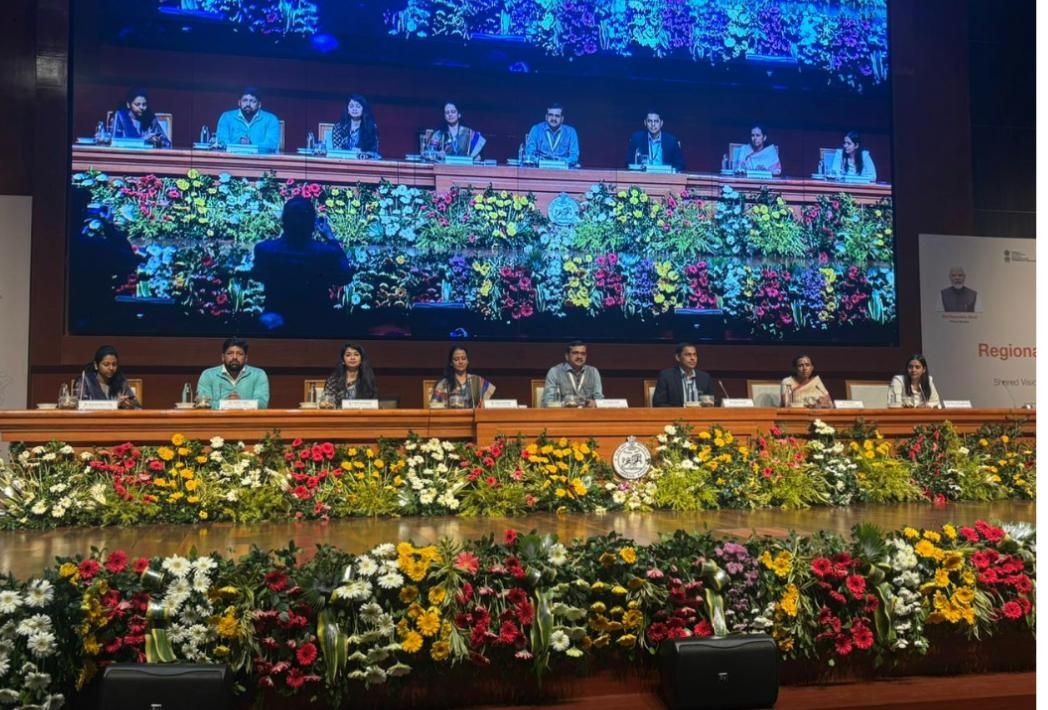
Bhubaneswar, 20 December 2025: The Regional AI Impact Conference, Odisha, jointly organised by the IndiaAI Mission, Ministry of Electronics and Information Technology (MeitY), and the Government of Odisha, concluded today at the Odisha State Convention Centre in Bhubaneswar.
Day 2 featured breakout sessions on language AI, governance, healthcare, and a keynote address, with key dignitaries drawing the successful conference to a close.
The Regional AI Impact Conference Odisha marks the third in the series of the Regional AI Impact Conferences, mobilising impact-driven dialogue and collaboration aligned with the ‘People, Planet, Progress’ sutras of the India AI Impact Summit 2026.
Regional AI Conferences: Building National AI Strategy from State Priorities
Regional AI Impact Conferences are set to take place across several states, serving as high-level platforms to showcase state-specific AI initiatives and foster multi-stakeholder dialogue.
The Conferences are designed to focus on themes aligned with each state’s strengths and priorities, providing platforms for states to showcase their AI initiatives in public service delivery, governance, and industrial applications.
These events aim to mobilise collaboration among governments, academia, industry, and startups, while preparing actionable recommendations that feed directly into the India AI Impact Summit 2026.
Guided by the sutras of People, Planet, and Progress that define the India AI Impact Summit 2026, the concluding day of the Regional AI Impact Conference, Odisha, showcased how India is operationalising this vision through domain-focused tracks such as Bhasha.AI, Sushasan.AI and Swasth.AI to make AI work in Indian languages, governance systems and healthcare for every citizen.
Day 2 brought together policymakers, domain experts and innovators across these themes, culminating in a closing ceremony that reaffirmed Odisha’s and India’s shared commitment to advancing AI-led, inclusive development on the road to Viksit Bharat 2047 and the India AI Impact Summit 2026.
Breakout Session: Bhasha.AI – Building AI for Odia
The breakout session on “Bhasha.AI – Building AI for Odia, moderated by Ashwini Kumar Rath, CEO, Batoi Systems, explored localised language models to preserve and empower Odia culture through technology.
Dr Bijay Ketan Upadhyaya, IAS, Secretary, Odisha Language Literature Culture Department, highlighted the urgent need to digitise Odia’s vast analogue heritage, from palm leaf manuscripts to tribal oral traditions, into AI training data, ensuring models capture Odisha’s cultural essence while enabling preservation, inclusion, and global engagement.
Prof. Nalini Ratha, SUNY-Buffalo, underscored the need for trustworthy Odia AI through multilingual handwriting recognition expertise, calling for efforts to achieve greater accuracy in digitising traditional manuscripts and dialects while addressing fairness, explainability, and toxicity challenges in data.
Mr Pradeep Rout, Head, Odia Virtual Academy, emphasised that AI must serve the masses, not just classes, acting as an enabler for domain experts while prioritising knowledge structuring, validated datasets, preservation of oral traditions and local technologies, and ethical compliance with the DPDP Act.
Mr Shakti Rath, AHRC, highlighted achieving 80% speech recognition accuracy and 55% handwritten text recognition for Odia despite limited training data, demonstrating HCL AI’s expertise from academia-industry collaborations to build robust local language models.
Breakout Session: Sushasan.AI – AI for Governance
In the “Sushasan.AI – AI for Governance” session moderated by Vijeeth Srinivas, Program Lead, AI Powered Odisha, Mr Vineet Bhardwaj, Centre for Modernising Government Initiative, highlighted AI’s potential to shift governance from reactive responses to predictive action, using rural drinking water supply as an example, where anticipating failures before citizens suffer represents true success over mere technology celebration.
Ms Maya Sherman, AI Expert, GPAI and Innovation Advisor, Israel Embassy, emphasised that AI governance is fundamentally about people, trust, and values, requiring citizen involvement in design, problem-first approaches, AI literacy, and transparent frameworks recognising AI’s power and limits.
Mr Niladri Bihari Mohanty, Joint Director (IT) & Head – AI & Innovation Cell, NIC, Odisha, underscored AI’s transformative role in seed management for India’s food security through data-driven supply chain predictions, emphasising robust infrastructure, realistic computing, and a mindset shift from jargon to scalable, cost-effective solutions.
Mr Abhaya Agrawal, Faculty of Emerging Technology, Wadhwani Foundation, emphasised building strong data foundations, departmental interoperability, and right use cases with open-source models and secure on-premise deployment for cost-effective AI that matches India’s scale, energy realities, and accountability needs.
In a presentation on “AI in Smartgrid, Prof. Subhransu R Samantaray, Associate Centre-Director, AI & HPC Research Centre, IIT Bhubaneswar, highlighted the shift from centralised grids to decentralised smart grids with 230 GW renewables, stressing AI automation for real-time monitoring, demand-side management, and handling inertia-less power systems.
In his virtual keynote address, Mr Raghav Gupta, Education Head, OpenAI, noted that learning has become one of AI’s most significant use cases globally and in India.
He emphasised AI’s potential to personalise learning, democratise access to tutoring, and build essential AI literacy, while highlighting the critical need for responsible integration.
Breakout Session: Swasth.AI: AI for Healthcare
The “Swasth.AI – AI for Healthcare” session focused on AI-driven solutions for public health challenges.
Dr Tapan Gandhi, Professor at IIT Delhi, showcased his work on adaptive intelligence for digital health, featuring AI-powered VR technologies for rapid blindness diagnosis at village levels, eye-brain retraining for the blind, automated visual field testing without doctor commands, and AI applications for autism detection, learning disabilities, and collaborations like nationwide eye screening grids.
Dr Prachi Karkhanis, Expert – MEL Gender, Wadhwani AI, noted that key shifts needed to break the “pilot trap” and build sustainable trust, capacities, and institutions co-designing with governments, investing in frontline digital readiness/change management, and embedding regulatory/responsible AI pathways with rigorous evaluations.
Moderated by Prattusha Mukhopadhyay, Samagra Governance, the panel was also attended by Ms. Aswathy S, Commissioner-cum-Secretary, Health and Family Welfare, Government of Odisha; Dr. Debasis Dash, Director, Institute of Life Sciences Bhubaneswar; Ms. Poorva Malviya, Head of Engineering, Noora Health; Mr. Sanjay Swain, Co-founder & CTO, CureBay; and Ms. Shyamashree Das, Senior Program Officer, Gates Foundation.
The conference concluded with a closing ceremony featuring Mr. Vishal Kumar Dev, Principal Secretary, Department of E&IT, Government of Odisha who affirmed the Regional AI Impact Conference’s success in moving from deliberations to concrete outcomes, highlighting global and diverse stakeholder participation and progress on India AI Mission’s goals of democratizing resources, self-reliance, and global leadership ahead of the India AI Impact Summit 2026, scheduled to take place from 15-20 February 2026.
As the Regional AI Impact Conference, Odisha, drew to a close, it reinforced a pan-India journey where Regional AI Impact Conferences from the hills of Meghalaya to the innovation hubs of Gujarat and now the eastern gateway of Odisha are stitching together a truly national AI fabric that leaves no geography behind.
More conferences are scheduled to take place in Jaipur, Lucknow, Indore, Thiruvananthapuram, and Hyderabad,d covering every corner of the nation to align with the vision of the honourable Prime Minister Shri Narendra Modi towards Viksit Bharat 2047.
These regional convenings are emerging as people-centric, state-led building blocks of the IndiaAI Impact Summit 2026, ensuring that the Summit’s sutra of People, Planet, Progress is advanced in service of the larger vision of “Welfare for all, Happiness of all”, shaped not just in New Delhi but in convention centres, campuses, and communities across the country.